








For years, the SEO community has insisted on this sacred principle: “Content is king.” This mantra has been repeated so often that it has become an ingrained belief. But is the starting point of technical SEO really the production of rich and abundant content?
Imagine constructing a building on a weak foundation with poor design and then trying to compensate for its structural flaws with lavish decorations and expensive furniture. This is precisely the metaphor for many businesses’ approach to SEO: focusing on “excellent” content while the site’s technical infrastructure( from the very design stage
)is full of fundamental obstacles for Google’s crawlers and users. This article presents a controversial challenge: Real and sustainable technical SEO does not begin with content strategy, but at the design table. If your website design is not optimized for search engines and user experience from the start, even the best content will be lost in the abyss of invisibility.
Here, we examine seven fundamental reasons why design is the undeniable cornerstone of technical SEO.
Information Architecture
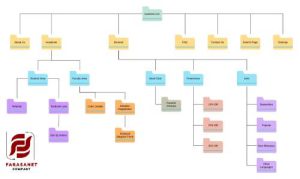
Information Architecture (IA) is the invisible backbone of your website. It is the structure and hierarchy of content, menus, and the connections between pages, determined during the design phase. Poor IA is like a city without signs or a map: users and Google’s crawlers get lost, dwell time decreases, and bounce rate increases. Google directly evaluates your “Topic Authority” through the site’s architecture. If your important pages are buried three or four clicks deep, their chances of proper indexing and ranking are severely diminished.
Conversely, an information architecture designed based on SEO principles (with logical categories, hierarchical URL structures, and strategic internal linking from the outset ) provides Google with a clear roadmap. This optimizes “Crawl Budget,” helps Google discover and understand important content faster, and circulates Link Equity throughout the site. Designing a strong IA before mass content production is like drawing a map before building a city; an essential task that is prohibitively expensive to fix later.
Core Web Vitals: Design Metrics, Not Copywriting
-
Rooted in Design: The critical metrics of LCP, FID, and CLS directly stem from technical choices made in the design phase (framework, resource management, loading architecture).
-
Prevention, Not Cure: Optimizing these metrics after design completion is often costly and ineffective. The real solution is preventive design with these components in mind.
-
A Design Feature: Speed and visual stability must be considered as fundamental design features from the start, not an afterthought for the optimization stage.
Read More! – Why Most Websites Fail at SEO, UX & Sales
Responsiveness and Mobile-First Indexing
With Google’s Mobile-First Indexing, the mobile version of your site is now considered the primary version for ranking. Designing a responsive site that provides a consistent experience across all devices is a technical SEO requirement. But this responsiveness is not just about the page “fitting” different sizes; it means Mobile-First Design: touch-friendly menus, adequately sized buttons, legible fonts on small screens, and performance optimization for mobile networks.
If your site design is desktop-centric from the start, even using CSS Media Queries, adapting it for mobile often results in content removal, restructuring of complex layouts, and ultimately a weaker version. This sends a negative signal to Google. An SEO-conscious designer creates wireframes and prototypes first for the smallest screen and then expands them for larger displays. This ensures that the core content, usability, and speed (three key SEO factors) are flawless in Google’s prioritized version (mobile).

Advanced Technical SEO
Implementing Schema Markup and Structured Data is no longer a “nice-to-have” feature but a necessity for earning Rich Snippets and improving Google’s understanding of content. However, effective Schema implementation requires a semantically coordinated design. Using meaningful HTML5 tags like <article>, <section>, and <nav> in the site template structure provides a solid foundation for connecting structured data.
A professional designer can design site templates and components (like comment sections, products, events, FAQs) so that space for JSON-LD implementation is considered from the beginning, and necessary elements are easily identifiable. If your design uses generic <div> tags for everything, adding Schema later will be a difficult and error-prone task. Therefore, design provides the platform for implementing structured SEO.
Read More! – Reasons Why Google Doesn’t Like Your Website
Optimization for User Experience (UX) and Engagement
Modern Google algorithms, especially the RankBrain and MUM ranking algorithms, seek to evaluate user satisfaction. Engagement Metrics like average page time, bounce rate, and CTR in search results are indirect ranking signals. A User-Centered Design, formed during the initial research and wireframing phase, directly impacts these metrics. Designing intuitive navigation, readable layouts, using whitespace, and clear Calls-to-Action (CTAs) increase user engagement.
If a user leaves your site quickly due to poor design and confusion, Google interprets this as a negative quality signal—even if your content is excellent. Producing valuable content on a poor design is like delivering an excellent speech in a hall with uncomfortable chairs, poor lighting, and a bad sound system. The audience won’t embrace the content. Therefore, good design creates the necessary platform for attracting and retaining the audience for your content.

Speed as a Design Feature (Speed by Design)
A website’s loading speed is not achieved solely by compressing images or enabling caching after launch. Speed must be a “design feature.” Choosing lightweight technologies (e.g., choosing between heavy React or a simpler approach), deciding on the use of heavy elements like sliders or autoplay videos on the homepage, and designing for lazy loading from the start all happen in the design phase.
An SEO-minded designer, understanding the impact of each element on site performance, advocates for “minimalist and functional design.” They collaborate with the developer to use optimized libraries, prioritize system fonts, and implement effective loading strategies. This approach ensures the site is born fast in its DNA, rather than having to go on a weight-loss diet later.
Read More! – The Hidden SEO Cost of “Stunning” Website Design
An Infrastructure for Future SEO Growth
A business grows, and its SEO strategy becomes more complex. If the site design is not Scalable and Maintainable from the start, with the addition of new pages, categories, and specialized content, the SEO structure collapses. Problems like Keyword Cannibalization, broken links, complex architecture, and Orphan Pages emerge.
An SEO-based design designs the Content Management System (CMS) and template structure so that scalability is built-in. For example, ensuring every page automatically receives meta tags, breadcrumb paths, and Related Content sections, or designing a flexible category and tagging system that doesn’t become chaotic as the site expands. This type of design provides an organized platform for endless future content production and prevents Technical Debt.

Design, The Overlooked Foundation of Technical SEO
The era of thinking “first produce content, then fix technical problems” is over. In today’s complex Google ecosystem, technical SEO is a preventive and infrastructural process whose success is determined in the Design Phase. Design defines the framework, crawlability, understanding, user experience, and speed of the site. Excellent content without this optimized framework is like fertile seeds scattered on barren rock—with little chance to grow and flourish.
If your goal is to achieve stable rankings resistant to algorithmic updates, you must change your perspective. Start SEO from the very first website design meeting. The design and SEO teams must work together from day zero with a common language. Ask information architects, UX designers, and front-end developers to adopt technical SEO metrics as part of the core design principles. This investment not only drastically reduces your future costs for technical fixes but also multiplies the chances of success for all your subsequent content production and link-building efforts.
Is your website built on a weak design foundation? It’s time for a deep and critical audit of your site’s design and technical SEO. Our expert team integrates design and SEO from the ground up with a preventive approach. To receive a specialized audit and strategic redesign, contact us today. Remember, tomorrow is too late; competitors are building steel structures while you might just be decorating an old building.
“For more information and consultation with FaraSanat’s expert specialists, take action now.”